
Unique Ways to Add Exercise at Work: Employee Reactions Revealed
Workplace exercise initiatives are transforming company cultures, with tangible results documented by health professionals and productivity specialists. Recent surveys reveal surprising employee reactions to innovative movement strategies that seamlessly integrate into daily work routines. This comprehensive guide examines twelve practical approaches that organizations have successfully implemented, based on evidence and feedback from those who have experienced the benefits firsthand.
- Scheduled Movement Windows Reduce Therapist Burnout
- Position Changes Improve Workshop Learning Outcomes
- Team Follows Leader Who Normalizes Daily Movement
- Walking Meetings Spark Creativity and Collaboration
- Mini Fitness Challenges Transform Lunch Breaks
- Tech-Free Walks Prevent Burnout and Reset Minds
- Office Park Focus Loop Enhances Productive Movement
- Calendar Microbursts Make Movement Team Culture
- Desk Breathwork Techniques Circulate Stagnant Energy
- Standing Desks Create Subtle Culture Shift
- Bike Commuter Bonus Rewards Eco-Friendly Transport
- Ankle Weights Allow Exercise Between Patients
Scheduled Movement Windows Reduce Therapist Burnout
I run a telehealth mental health practice, so our team is literally sitting all day doing back-to-back virtual sessions. About a year ago, I started blocking 10-minute “movement windows” between every third client slot across all therapist schedules–not optional breaks, but protected time where the expectation is you move your body.
What made it stick was making it weird on purpose. I sent everyone resistance bands, and we started a Slack channel where therapists post photos of the strangest places they’ve done stretches between sessions–one of our clinicians sent a picture doing lunges in her closet during a snack break. The competition and humor kept it from feeling like another wellness mandate that everyone ignores.
Our clinical quality actually improved because therapists weren’t hitting that 2pm brain fog wall anymore. Burnout scores on our internal check-ins dropped, and we retained two therapists who’d been considering cutting their caseload due to physical exhaustion from sitting. When your work is absorbing others’ emotional weight all day, even 10 minutes of jumping jacks makes you a better clinician for the next person.

Position Changes Improve Workshop Learning Outcomes
My focus on the prevention and rehabilitation of back problems leads me to delve deeply into the topic of movement during sedentary work. The biggest issue is that we often adopt a prolonged, rigid posture while concentrating. It’s important to exercise and find balance, for example, through Pilates. However, the challenge lies in incorporating movement into the act of sitting itself. Getting up occasionally or using exercise balls, which allow for micro-movements, can help.
For instance, in my Pilates workshop, I had participants move to a different position after each content-related section. Alternatives included standing, lying on their stomachs, sitting on an exercise ball, and sitting on the edge of a chair. This way, participants changed positions every 5-15 minutes, remaining active and mentally engaged. Everyone had the opportunity to reflect on how their own creativity developed. By the end of the workshop, the atmosphere was much better, and the learning outcomes were significantly improved.
This concept is ideal for meetings or workshops where participants would otherwise spend a lot of time sitting, listening, or speaking. Even taking notes is possible.
Team Follows Leader Who Normalizes Daily Movement
I’ve always kept a 16,000 step target, even on office days. To hit it, I started breaking my day into small walks inside the campus and I stopped using the elevator. Stairs became my quick cardio. My workouts are mostly done early morning, so I wasn’t asking anyone to do burpees at 3 pm. I just wanted movement to look normal.
Once people saw I could walk, lead the team, finish the hard tasks first, and still not miss a single meeting, they stopped thinking of movement as “time off.” We turned it into a short 3 pm movement break where one person picked the activity: walk, stretch, or stair loop. Because the most accountable person in the room was doing it, people joined in. During WFH I even shifted my gym session to lunch so I could work on my business in the morning, and no one noticed because deadlines were hit. The real takeaway is simple: when the person who ships work on time moves, the rest of the team feels they’re allowed to move too.
Walking Meetings Spark Creativity and Collaboration
One of the most effective ways we’ve incorporated physical activity into our workday is through walking meetings, which allow team members to step outside and engage with nature while handling business matters. Walking meetings serve a dual purpose – they provide light physical activity and a change of scenery that helps spark creativity and fresh thinking. This approach has become particularly valuable for brainstorming sessions and one-on-one discussions where movement seems to naturally enhance the quality of conversation. The informal setting has helped break down hierarchical barriers, resulting in more open communication and collaborative problem-solving among our teams.

Mini Fitness Challenges Transform Lunch Breaks
I turned our lunch breaks into mini fitness challenges. Nothing crazy, just ten-minute bursts where we use what is around us: lifting bundles of shingles, racing ladders, or timed plank holds on the flatbed trailer. I call it “Roof Camp.” It started as a joke, but within two weeks, the guys were keeping score and timing each other with their phones. It added a bit of friendly competition, gave everyone a mid-day energy kick, and honestly, it made the afternoons smoother. Productivity jumped roughly 15 percent that month because people came back recharged instead of sluggish.

Tech-Free Walks Prevent Burnout and Reset Minds
At our company, I found that implementing daily walks without technology has been the most effective way to incorporate physical activity into our workday. I personally committed to these walks as a mental reset during emotionally intense periods while building our startup, and later encouraged our team to adopt this practice. We designated specific times for these walks, treating movement as a scheduled, non-negotiable part of the day, similar to any important meeting. This approach has helped prevent burnout across our organization, allowing team members to step away from screens and reset mentally. While initially some team members viewed this as taking time away from “real work,” many have since reported increased productivity and clearer thinking after returning from their walks.

Office Park Focus Loop Enhances Productive Movement
The most creative thing we did was install a “Focus Loop”, a good old-fashioned half mile winding path that just happens to have some Wi-Fi and power outlets snuck in amongst the green space in our office park. We turned it into a real office staple by actively encouraging our developers and project managers to take their calls, review some code, or just get together and brainstorm while strolling the loop, instead of being stuck at their desks all day long.
Employees initially found it a little strange, but the response became fantastic. It really broke up the long seated periods and triggered far more creative problem-solving than sitting in a meeting room. It’s now the default spot for quick, productive one-on-one check-ins.

Calendar Microbursts Make Movement Team Culture
I could tell you to just put movement on the team calendar like it’s a meeting (but a good one!). Three-minute “speed challenges” every 90 minutes. Wall sits. Plank holds. Desk chair relays. You put it on a shared calendar with 15 seconds’ warning. The winner gets the honor of telling people at the meeting they came in second or something equally as absurd like a $5.00 trophy. Honestly, these 30-second microbursts energize people in ways a solo lunch at your desk cannot. It’s random, effortless, and let’s be honest…addictive.
Here’s the trick: your team will not rebel against moving when it becomes part of the culture as opposed to being a mandate. Once it’s woven into the fabric of your team, no one is going to want to opt out (even the introverts). And the funny part is that productivity tends to spike after these breaks, because dopamine does what deadlines can’t.

Desk Breathwork Techniques Circulate Stagnant Energy
I’ve found that one of the most creative and simplest forms of activities that can integrate movement into a modern work life is breathwork. Known as “Pranayama” in the East, this can be done right from your chair without leaving your work. Breathwork helps movement from inside out and circulates energy, especially stagnant energy from exhaustive work sitting in the same place all day long. The active oxygen intake that fills the deeper parts of the lungs, which one doesn’t normally fill when they breathe shallowly, brings improved focus and improved performance.
Here are five powerful breathwork techniques employees can use right at their desks:
Box Breathing (4-4-4-4)
Inhale for 4 seconds, hold 4, exhale 4, hold 4.
Why: It lowers stress hormones, steadies heart rate, and improves concentration before meetings or presentations.
Alternate Nostril Breathing (Nadi Shodhana)
Close one nostril at a time while alternating breaths.
Why: Balances both sides of the nervous system and helps to reset between intensive tasks at work.
Deep Belly Breathing (Diaphragmatic)
Inhale deeply through the nose, expanding the abdomen; exhale slowly.
Why: Activates the parasympathetic system, easing anxiety and improving digestion after lunch.
Cooling Breath (Sheetali or Sip Breath)
Inhale through pursed lips or rolled tongue, exhale through the nose.
Why: Reduces heat, frustration, and “mental burnout”. This is especially helpful in high-stress environments.
Energizing Breath (Kapalabhati / Short Active Exhales)
Quick, rhythmic exhales through the nose with passive inhales.
Why: Stimulates alertness, clears brain fog, and gives a caffeine-free energy boost during afternoon slumps.
Even 2 to 3 minutes of any of these can shift physiology and mood, helping to lower cortisol, increase oxygenation, and improve clarity. Employees often report feeling re-focused and more energized, without even leaving their desk or buying any exercise equipment.
I encourage organizations to normalize these micro-breaks as part of wellness culture. These techniques are cost-free and tremendously improve productivity. They help employees stay calm, focused, and resilient throughout the workday.

Standing Desks Create Subtle Culture Shift
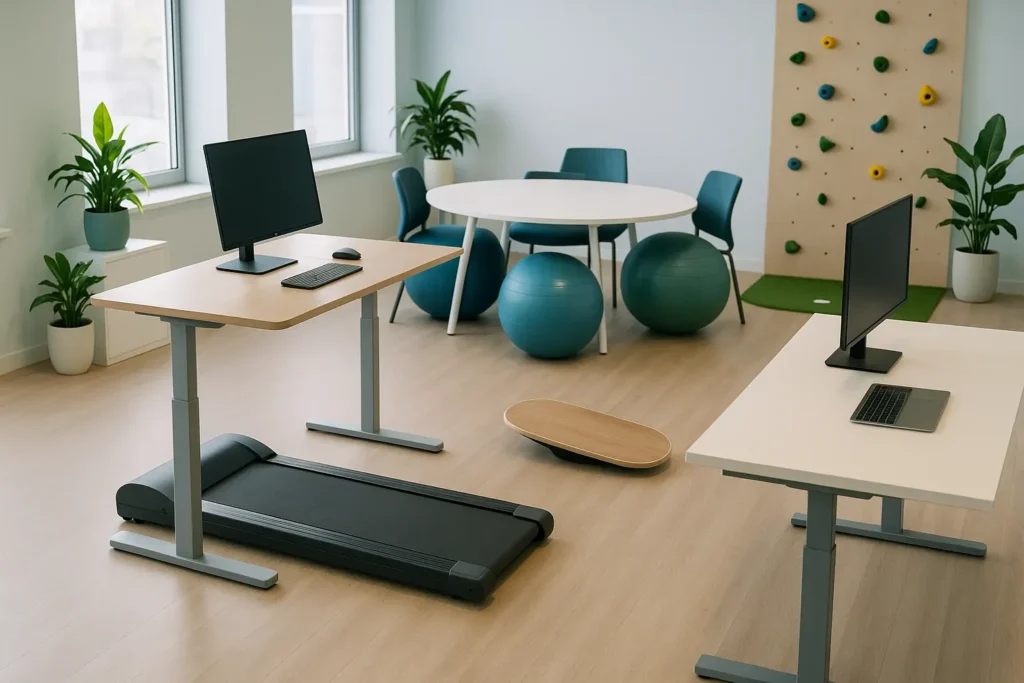
We introduced adjustable standing desks to encourage movement and break up long periods of sitting. What started as a small ergonomic upgrade evolved into a subtle culture shift—people began alternating between sitting and standing meetings, stretching during calls, and even walking in place while reviewing documents. It added a layer of energy and focus to the office without disrupting workflow. Employees appreciated the flexibility and autonomy, noting less fatigue and a noticeable boost in engagement throughout the day.

Bike Commuter Bonus Rewards Eco-Friendly Transport
We launched a “bike-commuter bonus” at Axion, where employees who cycle to work three or more times a week are eligible for extra annual leave hours. Cycling UK’s “Cycle to Work” (https://www.cyclinguk.org/article/guide-cycle-work-scheme-employers?) scheme shows how many UK firms already do this via tax-efficient salary sacrifice.
Employees love the scheme, and since we introduced the bonus, our bike-in numbers have doubled and parking space demand has dropped. It’s practical, eco-friendly, and the cycling commuters have reported fewer afternoon slumps.

Ankle Weights Allow Exercise Between Patients
Bringing ankle weights to work! As a cardiologist, I am so busy seeing patients that in between I can do donkey kickbacks a few times, seated leg raises, or simply walk with them on. This helps me tone while continuing my daily patient load.